
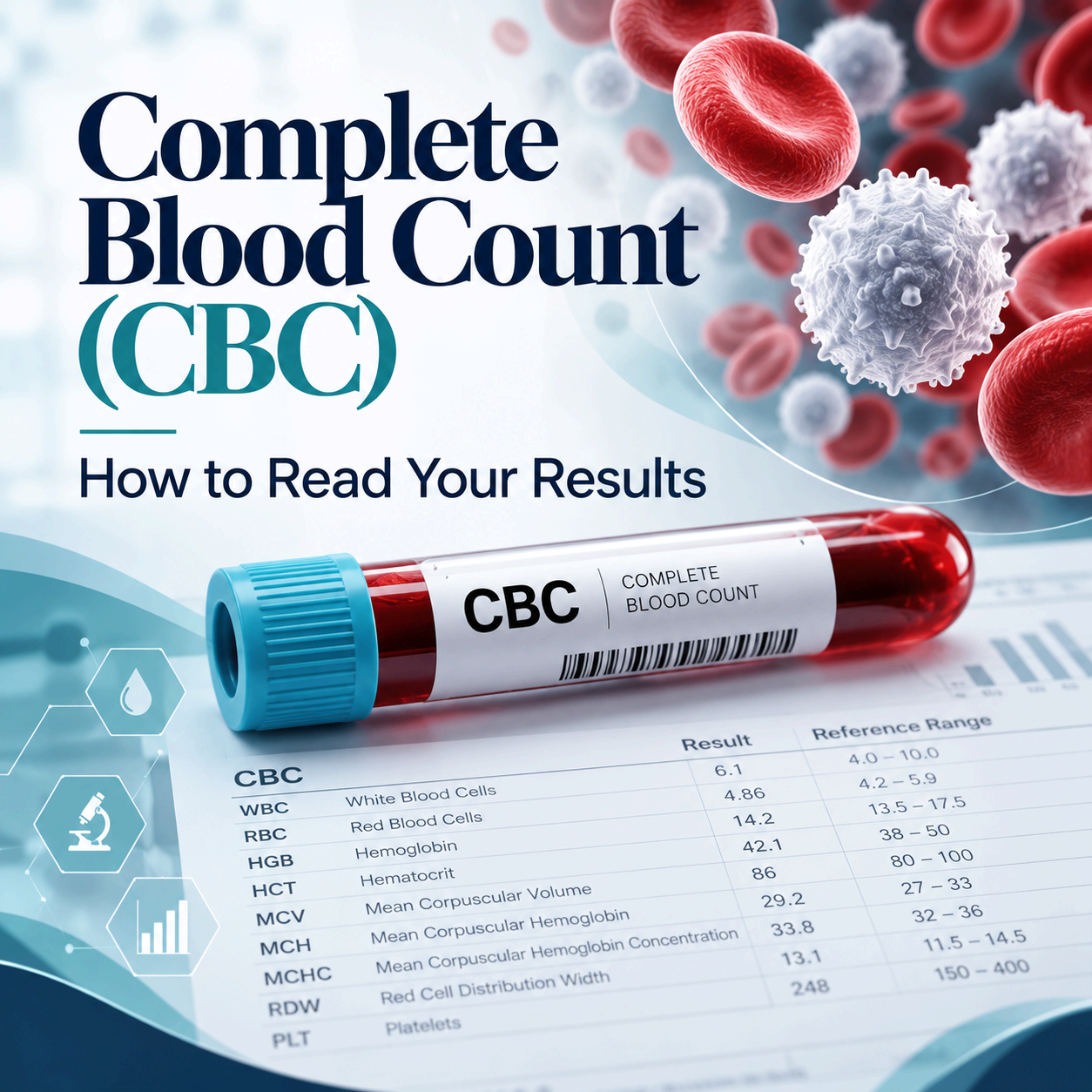
A complete blood count test (CBC) is a blood test that measures several important parts of your blood, including red blood cells, white blood cells, platelets, hemoglobin, hematocrit, and related red blood cell measurements.
It is one of the most commonly performed blood tests, but a CBC report can be surprisingly difficult to read. A single report may contain abbreviations such as WBC, RBC, Hgb, Hct, MCV, MCH, MCHC, RDW, and PLT, sometimes with an H or L beside the result.
A CBC is not one number, and an abnormal CBC result is not a diagnosis. The different measurements are usually interpreted together with your laboratory’s reference range, previous results, symptoms, medications, recent illness, and other health information.
This guide explains what a CBC measures, how the major values fit together, and how to approach a result that is marked high or low without treating one number as the whole answer.
What Is a Complete Blood Count Test?
A complete blood count is better understood as a group of blood measurements rather than one individual test result.
It provides information about three major parts of the blood:
- Red blood cells, which help carry oxygen throughout the body
- White blood cells, which are involved in immune defense
- Platelets, which help the blood clot
A CBC also commonly includes hemoglobin, hematocrit, and several measurements describing the size and characteristics of red blood cells.
This is why a CBC is usually most useful when the results are viewed as a pattern. A low hemoglobin value, for example, becomes more meaningful when it is considered together with hematocrit, RBC count, MCV, and RDW.
Why Is a CBC Test Ordered?
A healthcare professional may order a CBC during a routine checkup or when investigating symptoms, monitoring a medical condition, or following a treatment that may affect blood cells.
Situations in which a CBC may be considered include:
- persistent tiredness or weakness
- fever or possible infection
- unexplained bruising
- unusual bleeding
- dizziness or shortness of breath
- possible anemia
- ongoing inflammation
- monitoring a condition or treatment that may affect blood cells
CBC testing may also be repeated over time. In many situations, the direction of change can provide more useful context than a single isolated result.
A result that has been mildly stable for years may raise a different question from a value that has changed substantially since the previous test.
What Does a CBC Measure?
Most CBC reports contain a similar group of measurements, although the exact layout, units, and reference intervals can differ between laboratories.
| CBC measurement | What it mainly describes |
|---|---|
| WBC | Total number of white blood cells |
| RBC | Number of red blood cells |
| Hemoglobin, Hgb or Hb | Amount of oxygen-carrying hemoglobin in the blood |
| Hematocrit, Hct | Proportion of blood volume made up of red blood cells |
| MCV | Average size of red blood cells |
| MCH | Average amount of hemoglobin in each red blood cell |
| MCHC | Average concentration of hemoglobin inside red blood cells |
| RDW | Variation in red blood cell size |
| PLT | Number of platelets involved in clotting |
The most useful way to read this table is not as nine unrelated numbers. Several results describe the same group of blood cells from different angles.
White Blood Cell Count: WBC
WBC measures the total number of white blood cells circulating in the blood. White blood cells are an important part of the immune system.
WBC levels may change with infection, inflammation, physical stress, certain medications, immune-related conditions, and disorders affecting blood cell production or survival.
A high WBC does not automatically mean a bacterial infection, and a low WBC does not automatically mean a serious blood disorder. The total count is only the starting point.
If WBC is abnormal, it can be useful to check whether a white blood cell differential was also performed.
CBC vs. CBC With Differential
A standard CBC reports the total white blood cell count.
A CBC with differential adds information about the different types of white blood cells, commonly including:
- neutrophils
- lymphocytes
- monocytes
- eosinophils
- basophils
The report may show percentages, absolute counts, or both.
This distinction matters because two people can have similar total WBC results but different distributions of white blood cell types.
The differential can add context, but it still does not diagnose the cause of an abnormal result by itself.
Understanding the Red Blood Cell Part of a CBC
RBC Count
RBC measures the number of red blood cells. These cells contain hemoglobin and help transport oxygen from the lungs to tissues throughout the body.
A low or high RBC result should usually be reviewed with hemoglobin, hematocrit, and the red blood cell indices rather than interpreted independently.
Hydration, oxygen exposure, medical conditions, medications, and other individual factors can influence red blood cell measurements.
Hemoglobin: Hgb or Hb
Hemoglobin is the oxygen-carrying protein inside red blood cells.
Low hemoglobin is commonly associated with anemia, but anemia is a finding with many possible causes, not a single diagnosis.
Possible explanations can include blood loss, iron deficiency, vitamin deficiencies, chronic medical conditions, kidney-related problems, or conditions that affect blood cell production.
A CBC may show that hemoglobin is low, but additional information may be needed to determine why.
Hematocrit: Hct
Hematocrit describes the proportion of blood volume made up of red blood cells.
Hemoglobin and hematocrit often move in the same general direction. A low hematocrit may occur in patterns associated with anemia or blood loss, while a higher result may sometimes occur when blood becomes more concentrated.
Hematocrit is therefore best viewed together with RBC count, hemoglobin, and the surrounding clinical situation.
MCV
MCV, or mean corpuscular volume, describes the average size of red blood cells.
It can be particularly useful when hemoglobin is low because it helps characterize the red blood cell pattern.
- A lower MCV means the red blood cells are smaller on average.
- A higher MCV means they are larger on average.
Different medical and nutritional conditions can produce these patterns, so MCV alone cannot determine the cause.
MCH and MCHC
MCH refers to the average amount of hemoglobin in each red blood cell, while MCHC describes the average concentration of hemoglobin within the cells.
These are usually supporting measurements. They are more useful as part of a red blood cell pattern than as stand-alone findings.
RDW
RDW stands for red cell distribution width.
MCV describes average red blood cell size, whereas RDW reflects how much the sizes vary.
Two people can therefore have a similar MCV but different RDW results. This additional information may help a healthcare professional characterize an abnormal red blood cell pattern.
Platelet Count: PLT
Platelets are small blood components that play an important role in stopping bleeding and forming clots.
The platelet count is commonly shown as PLT.
Platelet numbers can change temporarily during illness or in association with inflammation, medications, bleeding, iron status, and other factors. Persistent abnormalities can have other explanations.
Instead of asking only whether the platelet count is high or low, consider:
- how far the result is from the laboratory reference interval
- whether the change is new
- whether it persists on repeat testing
- whether WBC or red blood cell measurements are also abnormal
- whether unusual bruising or bleeding is present
How to Read a CBC Report Step by Step
If your report contains an H or L flag, it is easy to jump directly to an internet search for a disease. A more useful approach is to read the report in a consistent order.
1. Identify the exact abnormal result
Is it WBC, hemoglobin, hematocrit, MCV, platelets, or another measurement?
2. Check your own laboratory’s reference interval
Do not replace the range on your report with a random range found online.
3. Notice how far the result is outside the range
A borderline result and a markedly abnormal result are not the same situation.
4. Review related CBC measurements
A flagged result becomes more informative when the related values are considered together.
5. Compare with previous CBC results
Look for stability, gradual change, or a new shift from your usual pattern.
6. Consider what was happening around the blood draw
Recent illness, medications, bleeding, menstruation, pregnancy, hydration, and other circumstances may affect some results.
Why Your Laboratory’s Reference Range Matters
There is no single online CBC reference table that should replace the interval printed on your laboratory report.
Reference ranges may vary with laboratory methods, equipment, measurement units, age, sex, pregnancy status, altitude, and other clinical factors.
Likewise, a result inside the reference interval does not guarantee that every health problem has been ruled out.
The laboratory range is a starting point for interpretation, not a substitute for the rest of your health information.
What Does an Abnormal CBC Mean?
An abnormal CBC means that one or more measurements fall outside the laboratory’s reference interval.
There are many possible reasons for this. Some are temporary or relatively minor, while others may require further evaluation.
The practical question is not simply, “Is this result abnormal?”
A more useful question is:
Depending on that overall picture, a healthcare professional may recommend observation, repeat testing, or more targeted tests.
What If Several CBC Values Are Abnormal?
Several abnormal measurements may require a different approach from one isolated borderline result.
For example, an isolated change in MCV does not create the same pattern as simultaneous changes in white blood cells, hemoglobin, and platelets.
When multiple blood cell groups are affected, clinicians may look for an explanation that connects the abnormalities and decide whether additional testing is appropriate.
The CBC alone does not determine what the next test should be. The next step depends on the pattern, degree of abnormality, symptoms, medications, history, and other findings.
Can Dehydration Affect CBC Results?
Yes. Hydration can influence some blood measurements because changes in plasma volume can affect how concentrated blood cells appear.
This may influence red blood cell-related results in some situations.
However, dehydration should not automatically be assumed to explain every elevated value. Persistent or substantial abnormalities still deserve appropriate interpretation.
Can an Infection Change CBC Results?
Yes. Infections can affect the total white blood cell count and the distribution of different white blood cell types.
But infection does not always cause a high WBC count.
Depending on the type of infection, timing, immune response, and individual circumstances, the total WBC may be elevated, within the reference range, or sometimes reduced.
This is one reason a CBC should support a clinical assessment rather than replace it.
Can a CBC Diagnose Cancer?
No. A CBC by itself cannot diagnose cancer.
Certain blood and bone marrow disorders, including some blood cancers, can produce abnormal blood cell counts. However, many noncancerous conditions can cause similar abnormalities.
An abnormal WBC, platelet, hemoglobin, or other CBC result therefore does not establish that cancer is present.
The reverse is also important: a normal CBC cannot rule out every type of cancer.
If a CBC shows a pattern that requires investigation, additional medical evaluation is needed to determine the cause.
Can You Have a Normal CBC and Still Be Unwell?
Yes.
A CBC measures specific characteristics of blood cells. It does not directly evaluate every organ, hormone, nutrient level, infection, inflammatory process, or medical condition.
A normal CBC may be reassuring in some circumstances, but it does not prove that every possible health problem has been excluded.
Persistent or worsening symptoms still deserve appropriate medical attention even when a CBC is within the laboratory reference intervals.
Do You Need to Fast Before a CBC?
A CBC by itself usually does not require special preparation or fasting.
There is an important exception: a CBC is often ordered with other blood tests. If another test requires fasting or specific preparation, those instructions may apply to the entire blood draw.
Follow the preparation instructions provided for your specific laboratory order.
What Happens During a CBC Blood Test?
A CBC normally requires a small blood sample drawn from a vein, usually in the arm.
- The skin is cleaned.
- A needle is inserted into a vein.
- A small amount of blood is collected into a tube.
- The needle is removed and pressure is applied to the site.
- The sample is sent for laboratory analysis.
You may feel a brief sting or discomfort during the blood draw. Mild bruising or tenderness can occur afterward.
Routine blood collection generally carries little risk, although bleeding, bruising, fainting, or infection can occasionally occur.
When Should an Abnormal CBC Be Followed Up?
Not every slightly abnormal result requires urgent treatment. Follow-up becomes more important when:
- the result is substantially outside the laboratory reference interval
- the value has changed significantly from previous testing
- the abnormality remains present on repeat testing
- several CBC measurements are abnormal at the same time
- a medication or medical condition may affect blood cells
- there are persistent or unexplained symptoms
Depending on the situation, follow-up may involve another CBC or more targeted testing.
Seek appropriate medical care for severe or rapidly worsening symptoms, significant unexplained bleeding, severe shortness of breath, fainting, chest pain, confusion, or other signs of a possible medical emergency. An online explanation of blood test numbers cannot determine the cause or severity of these symptoms.
Questions to Ask After an Abnormal CBC
Instead of asking only whether a number is “good” or “bad,” questions such as these may provide more useful context:
- How far outside the reference range is the result?
- Has it changed compared with my previous CBC?
- Are the related CBC measurements normal?
- Could a medication, recent illness, bleeding, or another temporary factor have affected it?
- Should the CBC be repeated?
- Is another test needed to investigate the cause?
- Are there symptoms that should prompt earlier medical attention?
Frequently Asked Questions
Is a CBC the same as a blood test?
No. A CBC is one type of blood test. Other blood tests may measure glucose, cholesterol, liver enzymes, kidney-related markers, electrolytes, hormones, nutrients, or many other substances.
Is a CBC with differential better than a regular CBC?
Not necessarily. They provide different levels of information. A CBC gives the total WBC count along with red blood cell and platelet measurements. A differential adds information about individual white blood cell types. Which test is useful depends on why testing is being performed.
Why is my CBC abnormal if I feel healthy?
A mildly abnormal result does not always indicate disease. Reference intervals have limits, and temporary factors or normal biological variation may affect results. The amount of change, related measurements, previous results, and whether the abnormality persists all matter.
Can a CBC show anemia?
A CBC can identify a pattern consistent with anemia, particularly through hemoglobin, hematocrit, RBC count, and red blood cell indices. Additional testing may be needed to determine the cause.
Does a normal CBC rule out infection?
No. An infection can occur without a high WBC count. The CBC result depends on the type and timing of the illness, the immune response, and other individual factors.
Should I worry about one H or L flag?
Not automatically. First identify which measurement is flagged, how far it is outside your laboratory’s range, whether related values are abnormal, and whether the change is new or persistent.
The Bottom Line
A complete blood count test provides a broad look at red blood cells, white blood cells, platelets, hemoglobin, hematocrit, and several related measurements.
The value of a CBC comes from the pattern, not from one isolated H or L flag.
Start with the reference interval on your own laboratory report. Then review related CBC measurements, compare the result with previous testing, and consider symptoms and circumstances around the blood draw.
A CBC can show that something deserves closer attention, but it often cannot explain the cause by itself.
Understanding the report is therefore less about finding one “good” or “bad” number and more about understanding how the measurements fit together and when further medical evaluation may be appropriate.
This article provides general educational health information only. It is not a diagnosis and does not replace professional medical advice, examination, diagnosis, treatment, prescriptions, or emergency medical care. Individual test results may have different meanings depending on age, medical history, medications, symptoms, pregnancy status, testing methods, and other factors.