
Vitamin D deficiency is easy to misunderstand.
A blood test can show a low vitamin D level even when you feel completely well. At the same time, symptoms such as fatigue, muscle aches, or weakness are common enough that they cannot tell you whether vitamin D is actually low.
The best place to start is not with a supplement bottle. Start with the test that was measured, how low the result is, and why the level may have fallen.
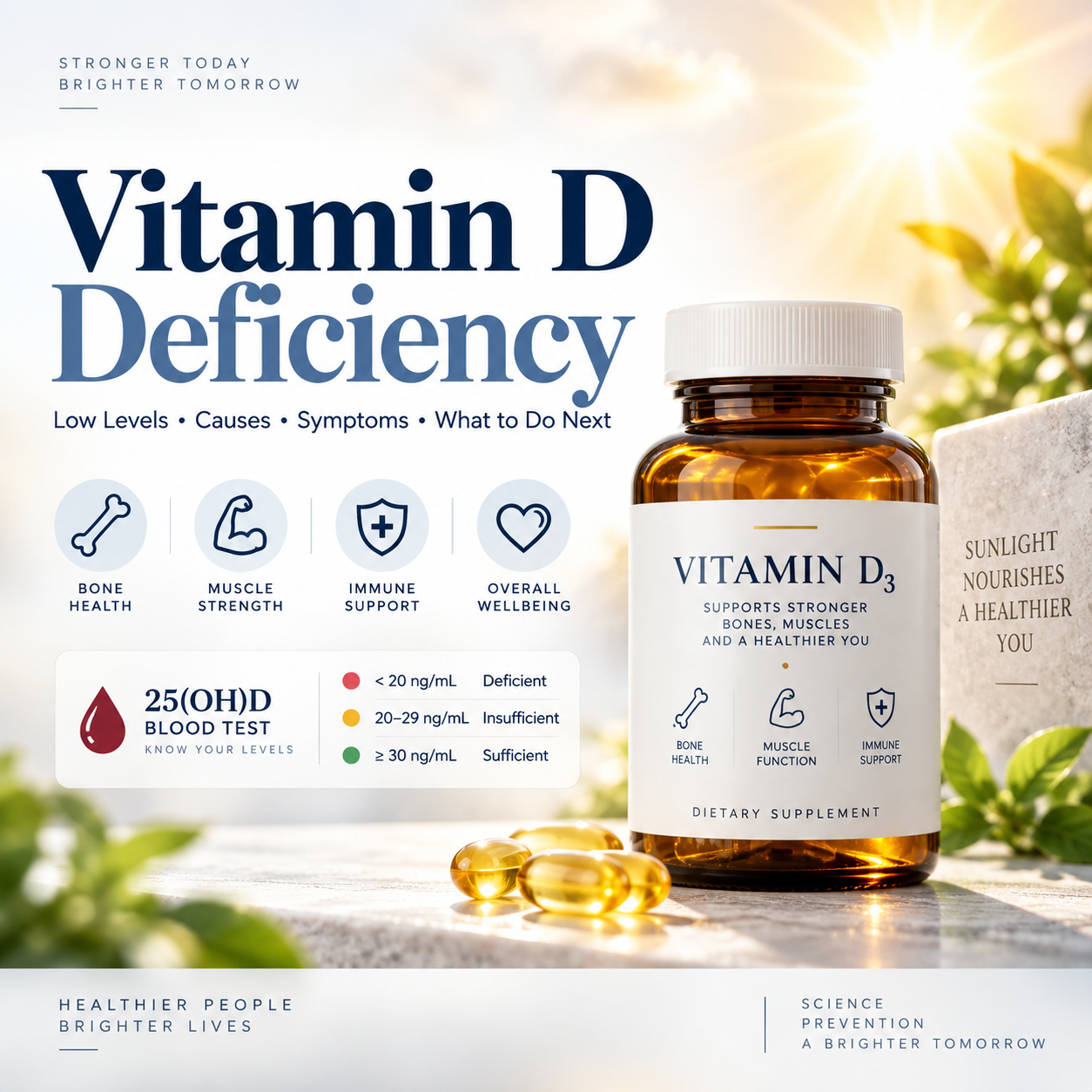
Vitamin D status is usually assessed with a blood test called 25-hydroxyvitamin D, or 25(OH)D. Levels below 12 ng/mL are associated with vitamin D deficiency, while 20 ng/mL or higher is generally adequate for most healthy people under the National Academies framework. These numbers describe vitamin D status, but they do not automatically determine the treatment or supplement dose that every person needs.
Start With the Test: 25(OH)D
The blood test most commonly used to evaluate vitamin D status is 25-hydroxyvitamin D, usually written as 25(OH)D.
Another test called 1,25-dihydroxyvitamin D measures the active form of vitamin D. Despite its name, it is not normally the test used simply to determine whether vitamin D stores are adequate. It may be used in selected situations involving kidney function, calcium metabolism, or other medical conditions.
If you are looking at a laboratory report, check both the test name and the unit.
Results are commonly reported in:
- ng/mL
- nmol/L
1 ng/mL = 2.5 nmol/L
20 ng/mL = 50 nmol/L
What Vitamin D Levels Actually Mean
Vitamin D numbers are often presented online as if there were one universal line separating “normal” from “deficient.” The reality is more nuanced.
| 25(OH)D level | General interpretation | What it does not automatically mean |
|---|---|---|
| Below 12 ng/mL | Associated with vitamin D deficiency | The number alone does not determine the exact treatment dose |
| 12 to below 20 ng/mL | May be inadequate for bone and overall health | Not everyone needs the same supplement plan |
| 20 ng/mL or higher | Generally adequate for most healthy people | It is not necessarily the treatment target for every medical condition |
| Above 50 ng/mL | Higher concentrations may be associated with adverse effects | Higher is not automatically healthier |
The important distinction is this: a nutritional reference range is not the same thing as a universal treatment threshold.
A result can help describe vitamin D status, but age, bone health, calcium levels, medications, kidney or liver disease, intestinal absorption, and the reason the test was ordered may all influence what happens next.
Does Everyone Need to Reach 30 ng/mL?
No universal rule says every healthy adult must maintain a vitamin D level above 30 ng/mL.
Some clinical settings have historically used higher targets, particularly when managing specific bone or metabolic conditions. However, current evidence does not establish one 25(OH)D target that improves health outcomes for every otherwise healthy adult.
A result of 23, 26, or 29 ng/mL does not automatically mean that every person has a disease or should begin high-dose vitamin D. Laboratory reference ranges and individualized treatment targets are different concepts.
Vitamin D Deficiency Can Be Silent
Many people with a low vitamin D level have no obvious symptoms.
When deficiency becomes more severe or continues for a long time, it can interfere with normal bone mineralization. In adults, severe deficiency may contribute to osteomalacia.
Possible features can include:
- bone discomfort or tenderness
- muscle weakness
- reduced muscle function
These symptoms are not specific to vitamin D deficiency.
Fatigue is a particularly common source of confusion. Someone who feels tired may search for vitamin D deficiency and assume the two are directly connected. But fatigue can also be related to anemia, thyroid conditions, sleep problems, infections, medications, mental health conditions, nutrition, and many other causes.
Fatigue alone is not a reliable indicator of vitamin D deficiency.
Why Vitamin D Levels Become Low
A low result usually reflects a problem somewhere along the path from obtaining vitamin D to absorbing, processing, or using it.
For one person, the main issue may be limited dietary intake and little sunlight exposure. For another, the level may stay low despite supplements because absorption is impaired.
Low intake and limited vitamin D production
Only a limited number of foods naturally contain substantial amounts of vitamin D.
Useful dietary sources include:
- fatty fish such as salmon, trout, tuna, and mackerel
- egg yolks
- some mushrooms
- fortified milk
- fortified plant-based beverages
- fortified cereals and other foods
The skin can also produce vitamin D after exposure to ultraviolet B radiation from sunlight.
However, vitamin D production varies according to season, latitude, age, skin pigmentation, clothing, and other factors. This makes advice such as “get exactly 15 minutes of sun every day” unreliable.
Increasing unprotected ultraviolet exposure is also not a preferred treatment strategy because excessive UV exposure can damage the skin and increase skin cancer risk.
When absorption becomes the issue
Vitamin D is fat-soluble, so conditions that interfere with fat absorption can increase the likelihood of a low level.
Examples may include certain cases of:
- celiac disease
- Crohn’s disease
- cystic fibrosis
- chronic liver disease
- other disorders involving fat malabsorption
Certain forms of bariatric surgery can also reduce absorption.
This becomes especially relevant when someone has been taking vitamin D consistently but the level remains unexpectedly low.
When a level does not rise as expected, increasing the dose is not always the first question. The reason for the poor response may need to be investigated.
Age, body composition, medications, and illness
Older adults generally produce less vitamin D in the skin than younger adults.
Obesity is also associated with lower measured 25(OH)D concentrations.
Kidney and liver function are involved in vitamin D metabolism, and some medications can affect vitamin D status or bone health.
This is one reason the same laboratory result should not automatically trigger the same treatment in every person.
Routine Testing Is Not Necessary for Everyone
Vitamin D testing and vitamin D supplementation are two separate questions.
For otherwise healthy adults without symptoms or another clinical reason for testing, routine vitamin D screening is generally not recommended as a universal practice.
The U.S. Preventive Services Task Force states that evidence is insufficient to determine the balance of benefits and harms of screening asymptomatic, community-dwelling, nonpregnant adults.
The Endocrine Society’s current guidance also suggests against routine 25(OH)D testing in generally healthy adults when there is no established indication for testing.
This does not mean vitamin D is unimportant. It means that repeatedly measuring a number in every healthy person has not been shown to improve health outcomes.
Testing may still be appropriate when vitamin D status is relevant to a medical problem, such as certain bone disorders, calcium abnormalities, malabsorption, or another clinical condition.
Older Adults: Testing and Supplementation Are Different Decisions
One important example is adults age 75 and older.
Current Endocrine Society guidance suggests empiric vitamin D supplementation for generally healthy adults in this age group because of potential health benefits, while also suggesting against routine blood testing solely to determine who should receive supplementation.
That distinction matters:
- not needing routine testing does not mean vitamin D intake is irrelevant
- having a low test result does not mean everyone requires the same treatment dose
Daily Intake Is Not the Same as a Deficiency Treatment Dose
Population-level dietary recommendations are designed to meet the nutritional needs of most healthy people.
| Age | General recommended intake |
|---|---|
| Adults 19–70 | 600 IU (15 mcg) per day |
| Adults 71 and older | 800 IU (20 mcg) per day |
These amounts can come from food, fortified foods, and supplements.
They are not treatment doses for confirmed vitamin D deficiency.
Someone with significant deficiency, impaired absorption, osteoporosis, or another medical condition may need a different plan determined by the clinical situation.
Before Adding a Supplement, Check the Total Dose
One of the easiest mistakes is taking vitamin D from several products without realizing it.
Vitamin D may already be included in:
- a multivitamin
- a calcium supplement
- a bone-health formula
- a mineral combination product
- another vitamin supplement
Labels may list vitamin D in micrograms or International Units.
1 mcg = 40 IU
Before adding another product, calculate the total amount of vitamin D already present in everything you take.
D2 vs D3 Is Not the First Question
Vitamin D supplements commonly contain either vitamin D2, or ergocalciferol, or vitamin D3, or cholecalciferol.
Both forms can increase vitamin D levels.
If you are trying to understand a low test result, more important questions come first:
- Do you actually need supplementation?
- How much vitamin D are you already taking?
- Why is your vitamin D level low?
The detailed differences between D2 and D3 are better considered separately when choosing a supplement. They should not distract from identifying the reason for the deficiency itself.
More Vitamin D Is Not Better
Vitamin D is fat-soluble, and excessive supplemental intake can lead to an abnormally high calcium concentration in the blood, known as hypercalcemia.
This is the main pathway behind many serious effects of vitamin D toxicity.
Possible symptoms and complications can include:
- nausea or vomiting
- weakness
- excessive thirst
- frequent urination
- dehydration
- kidney problems
- kidney stones
- abnormal heart rhythms in severe cases
Vitamin D toxicity is generally associated with excessive supplemental intake rather than normal food intake or ordinary sun exposure.
For adults, the general tolerable upper intake level is 4,000 IU, or 100 mcg, per day. This is a population-level safety boundary for routine intake. It does not mean every adult should take 4,000 IU, and exceeding it does not mean toxicity occurs immediately. Higher doses may sometimes be used for a specific medical reason under appropriate supervision.
How to Read a Result of 10 or 20 ng/mL
If your 25(OH)D is around 10 ng/mL
A result of 10 ng/mL is below the 12 ng/mL level associated with vitamin D deficiency in the National Academies framework.
It deserves more attention than a borderline result, but the number alone still does not determine the entire treatment plan.
Factors that may need to be considered include:
- the reason the level became low
- bone symptoms or fracture risk
- calcium levels
- intestinal absorption
- kidney or liver function
- medications
- previous supplementation
If your 25(OH)D is around 20 ng/mL
A level of 20 ng/mL or higher is generally considered adequate for most healthy people under the National Academies framework.
That does not mean 20 ng/mL is an appropriate target for every medical condition.
Someone being managed for a specific bone disorder or another clinical condition may have different treatment considerations.
For an otherwise healthy adult, however, it is misleading to assume that every value below 30 ng/mL represents clinically important deficiency.
When a Low Result Needs More Individualized Review
Consider discussing a low vitamin D result with a healthcare professional when it occurs with:
- a markedly low 25(OH)D result
- persistent bone pain or significant muscle weakness
- osteoporosis or fragility fractures
- abnormal calcium levels
- intestinal malabsorption
- bariatric surgery
- kidney or liver disease
- medications that may affect vitamin D or bone metabolism
- levels that remain low despite appropriate supplementation
- plans to use high-dose vitamin D for a prolonged period
The key question is not simply, “How can I make the number higher?”
A better question is, “Why is the number low, and what approach makes sense for the reason?”
Four Things to Check Before You Act
Look for 25-hydroxyvitamin D or 25(OH)D.
Make sure you know whether the result is reported in ng/mL or nmol/L.
Reference ranges and treatment targets are not the same thing.
Check multivitamins, calcium products, and combination supplements before adding more vitamin D.
Frequently Asked Questions
Is a vitamin D level of 10 ng/mL deficient?
Yes. A 25(OH)D level of 10 ng/mL is below the 12 ng/mL level associated with vitamin D deficiency in the National Academies framework.
The result should be interpreted together with possible causes, bone health, calcium levels, absorption problems, medications, and other clinical factors.
Is 20 ng/mL vitamin D normal?
For most healthy people, a 25(OH)D level of 20 ng/mL or higher is generally considered adequate for bone and overall health under the National Academies framework.
Individual treatment goals can differ when a specific medical condition is being managed.
Does anything below 30 ng/mL mean vitamin D deficiency?
No. A universal 30 ng/mL cutoff should not be used to label every healthy person as deficient.
Some clinical situations may use different targets, but current evidence does not support one universal 25(OH)D goal for all adults.
Can low vitamin D make you tired?
Fatigue can occur in people who have low vitamin D, but it is not a reliable or specific sign of deficiency.
Persistent fatigue has many potential causes and should not automatically be treated as a vitamin D problem.
Should everyone get a vitamin D test every year?
No. Routine repeated vitamin D testing is generally not recommended for otherwise healthy adults who do not have a clinical reason for testing.
Testing becomes more useful when the result could change management of a relevant medical condition.
Can I take 5,000 IU of vitamin D every day?
5,000 IU per day is above the general adult tolerable upper intake level of 4,000 IU.
Being above the upper limit does not mean toxicity will occur immediately. However, long-term intake above that level should not be treated as routine self-supplementation without a specific reason and appropriate medical guidance.
How long does vitamin D deficiency take to improve?
There is no single timeline that applies to everyone.
The response can depend on the starting level, supplement dose, consistency of use, absorption, body composition, medical conditions, and the underlying reason for the deficiency.
Follow-up testing, when necessary, should be based on the clinical situation rather than repeatedly measuring vitamin D simply to chase a particular number.
Bottom Line
Vitamin D deficiency is not simply a question of whether your laboratory result is below 20 or 30 ng/mL.
Start by confirming that the test is 25(OH)D and checking the unit.
Levels below 12 ng/mL are associated with deficiency, while 20 ng/mL or higher is generally adequate for most healthy people under the National Academies framework. But those ranges should not be confused with a universal treatment threshold or an ideal target for every person.
Many people with low vitamin D have no obvious symptoms, and nonspecific complaints such as fatigue cannot diagnose a deficiency.
If your level is clearly low, repeatedly low, or occurs alongside bone disease, malabsorption, abnormal calcium levels, kidney or liver disease, or other significant medical issues, identifying the reason for the low level is more useful than simply choosing the highest-dose supplement available.
Vitamin D matters, but the goal is not to chase the highest possible number. The goal is to maintain an appropriate level safely and in a way that fits your health situation.
Medical information notice: This article is for general health information and does not replace individualized diagnosis, treatment, or advice from a qualified healthcare professional.
Authoritative References
- National Institutes of Health, Office of Dietary Supplements — Vitamin D: Fact Sheet for Health Professionals
- U.S. Preventive Services Task Force — Vitamin D Deficiency in Adults: Screening
- Endocrine Society — Vitamin D for the Prevention of Disease Clinical Practice Guideline
- MedlinePlus — Vitamin D Test