
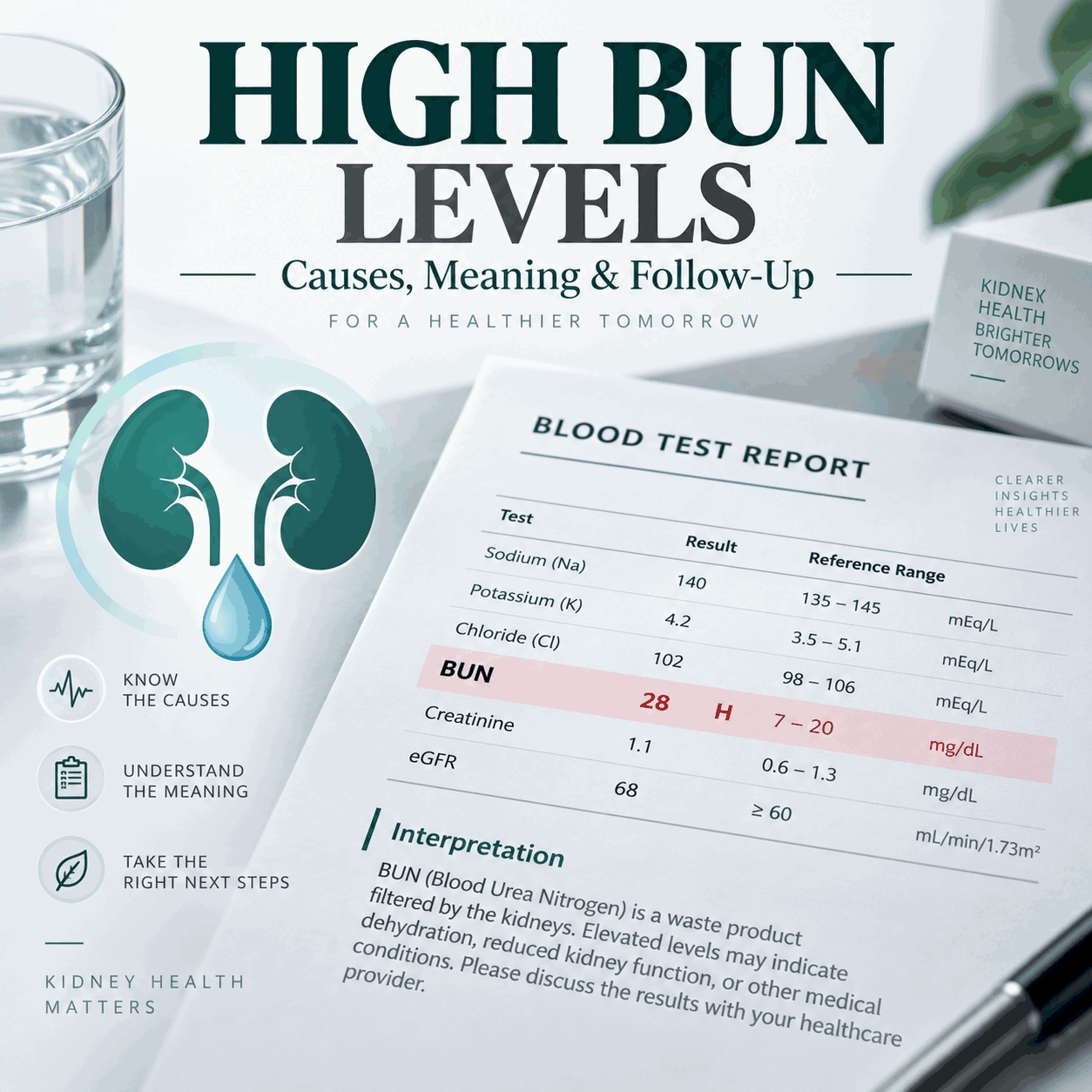
A high BUN result can make kidney disease the first thing that comes to mind. But an elevated blood urea nitrogen level does not automatically mean that your kidneys are damaged. BUN can rise with dehydration, reduced kidney function, higher protein intake, gastrointestinal bleeding, certain medications, reduced blood flow to the kidneys, and other medical conditions. The result is most useful when it is interpreted together with creatinine, eGFR, urine testing when appropriate, previous results, symptoms, and medical history.
What Is BUN?
BUN stands for blood urea nitrogen. Urea is a waste product formed when the body breaks down protein. It travels through the bloodstream to the kidneys, where it is filtered and removed in urine.
A BUN test measures the amount of nitrogen from urea in the blood. It is commonly included in routine chemistry testing and may help provide information about kidney function. However, BUN is only one part of kidney assessment because its level can change for reasons that are not caused by chronic kidney disease.
What Does a High BUN Level Mean?
A high BUN result means that more urea nitrogen than expected is present in the blood. This can happen when the kidneys are clearing urea less effectively, when the body is producing more urea, or when the amount of circulating fluid is reduced.
| Possible reason | Why BUN may rise | What may help with interpretation |
|---|---|---|
| Dehydration | Reduced circulating fluid can concentrate urea and reduce blood flow through the kidneys. | Recent vomiting, diarrhea, fever, heavy sweating, poor fluid intake, blood pressure, and repeat testing. |
| Reduced kidney function | The kidneys may not remove urea as efficiently. | Creatinine, eGFR, urine albumin, urinalysis, previous results, and medical history. |
| Higher protein intake | More protein metabolism can increase urea production. | Recent dietary changes, protein supplements, and the rest of the laboratory pattern. |
| Gastrointestinal bleeding | Digested blood increases the protein load processed by the body. | Symptoms such as black stools, vomiting blood, weakness, or lightheadedness require medical evaluation. |
| Medications or other illness | Certain medicines and medical conditions can affect BUN directly or indirectly. | Medication review, symptoms, other laboratory values, and the reason the test was ordered. |
Common Causes of High BUN Levels
1. Dehydration
Dehydration is a common non-kidney reason for an elevated BUN. It may occur after inadequate fluid intake, repeated vomiting, diarrhea, fever, heavy sweating, or another cause of fluid loss.
If the blood test was performed shortly after an illness or a period of poor fluid intake, that context may matter. Still, dehydration should not automatically be assumed to be the explanation, particularly when creatinine, eGFR, urine output, or other findings are also abnormal.
2. Reduced kidney function
The kidneys normally filter urea from the blood. When filtration is reduced, BUN may increase. But BUN alone is not the main test used to diagnose chronic kidney disease.
NIDDK identifies eGFR and urine albumin as key markers for detecting and monitoring chronic kidney disease. Creatinine, BUN, electrolytes, urinalysis, and other tests may also be considered depending on the clinical situation.
3. Higher protein intake
Because urea is produced during protein metabolism, a high-protein diet can increase BUN in some people. A recent major change in diet or use of protein supplements may therefore be relevant when an unexpected result is reviewed.
That does not mean protein intake alone explains every elevated result, and it does not mean that one high BUN value proves kidney damage. Avoid making major dietary restrictions based only on a single laboratory number.
4. Gastrointestinal bleeding
Bleeding in the gastrointestinal tract can raise BUN because digested blood acts as an additional protein load. BUN cannot determine whether gastrointestinal bleeding is present, so symptoms and other clinical findings matter.
5. Medications and other medical conditions
Certain medications and medical conditions can affect BUN. Established medical references also list situations such as urinary obstruction, reduced blood flow, severe burns, shock, and some heart-related conditions among possible contributors.
Do not stop or change a prescription medication because of a BUN result without discussing it with the healthcare professional who prescribed it.
What Is a Normal BUN Range?
A commonly cited adult reference range is approximately 6 to 20 mg/dL, but this is not a universal cutoff. Laboratories may use different methods and reference intervals, and BUN can vary with factors such as age and sex.
What If My BUN Is 25, 30, or 40?
Specific numbers such as 25, 30, or 40 mg/dL are commonly searched online, but they cannot be interpreted reliably without context.
If your laboratory uses a reference interval near 6–20 mg/dL, each of those values would be above that particular range, and 40 would be farther above the upper limit than 25. But none of these numbers is, by itself, a diagnosis or a universal emergency threshold.
The meaning depends on factors such as:
- Creatinine
- eGFR
- Previous BUN measurements
- Hydration status
- Recent illness or fluid loss
- Protein intake
- Medications
- Urine findings
- Age and medical history
A trend across multiple tests is often more informative than one isolated result.
Why Creatinine and eGFR Matter When BUN Is High
Creatinine is another waste product that is removed by the kidneys. Serum creatinine is used to estimate eGFR, which provides an estimate of kidney filtration.
High BUN with high creatinine
When BUN and creatinine are both elevated, reduced kidney filtration is one possible explanation. However, the pattern does not identify a specific cause on its own. Dehydration, reduced blood flow to the kidneys, urinary obstruction, acute kidney injury, medications, and other conditions may need to be considered.
High BUN with normal creatinine
BUN can sometimes be elevated while creatinine remains within the laboratory range. This may occur because BUN is influenced by dehydration, protein metabolism, gastrointestinal bleeding, and other factors that do not affect creatinine in exactly the same way.
A normal creatinine value also does not completely rule out kidney disease in every situation. When risk or clinical concern remains, eGFR and urine albumin testing may provide additional information.
What About the BUN-to-Creatinine Ratio?
Some laboratory reports or clinicians also consider the BUN-to-creatinine ratio. It may provide additional clues in certain situations, particularly when evaluating changes in kidney perfusion or trying to understand why BUN and creatinine are changing differently.
The ratio should not be treated as a stand-alone diagnostic formula. BUN is influenced by diet, gastrointestinal bleeding, hydration, illness, and other factors, so the ratio must be interpreted in clinical context.
Does High BUN Cause Symptoms?
There is no unique symptom pattern that proves a person has a high BUN level. Symptoms, when present, usually come from the underlying cause rather than from a mildly abnormal BUN result itself.
- Dehydration may cause thirst, dizziness, weakness, or reduced urine output.
- Gastrointestinal bleeding may cause black stools, vomiting blood, weakness, or lightheadedness.
- Early kidney disease may cause no noticeable symptoms.
- More advanced kidney problems may be associated with changes in urination, swelling, fatigue, appetite changes, or other symptoms.
Feeling well therefore does not automatically explain away an abnormal result, just as an elevated BUN alone does not diagnose a disease.
Can Dehydration Raise BUN While Creatinine Is Normal?
Yes, it can. BUN and creatinine respond differently to changes in hydration and protein metabolism, so BUN may rise disproportionately in some cases of reduced fluid volume.
But this pattern is not specific enough for self-diagnosis. Hydration history, blood pressure, symptoms, fluid losses, medications, urine findings, creatinine, eGFR, and the overall laboratory pattern may all matter.
Should I Drink More Water Before a Repeat BUN Test?
Normal hydration is reasonable for most people, but deliberately drinking a very large amount of water to make a laboratory number look lower is not a useful way to determine why BUN was elevated.
A BUN test by itself usually does not require special preparation, although other blood tests performed at the same time may require fasting or other instructions.
What Should You Check After a High BUN Result?
- Check the BUN reference range printed by your laboratory.
- Look at your creatinine result.
- Check whether eGFR is reported.
- Compare the result with previous BUN measurements.
- Think about recent vomiting, diarrhea, fever, illness, or heavy sweating.
- Note any major recent changes in protein intake.
- Review medications and supplements.
- Check whether urinalysis or urine albumin testing was performed.
- Ask whether repeat testing is appropriate for your situation.
For people with kidney disease or risk factors for kidney disease, urine albumin testing can provide important information that a blood test alone does not. NIDDK identifies urine albumin and eGFR as the two key markers used to detect and monitor chronic kidney disease.
When Should High BUN Be Followed Up?
Follow-up becomes more important when the abnormality persists or appears together with other abnormal findings.
Consider discussing the result with a healthcare professional when:
- BUN remains elevated on repeat testing.
- Creatinine is also elevated.
- eGFR is lower than expected.
- Urine testing is abnormal.
- You have diabetes, high blood pressure, cardiovascular disease, or known kidney disease.
- Your urine output has changed noticeably.
- You have persistent vomiting or diarrhea.
- You develop swelling in the feet or legs.
- You have ongoing unexplained weakness, fatigue, or other symptoms.
Chronic kidney disease is generally identified by persistent evidence of kidney damage and/or reduced kidney function lasting more than three months, rather than by one isolated abnormal BUN value.
When to Seek Prompt Medical Care
Do not delay urgent medical care while trying to interpret a laboratory result online.
Frequently Asked Questions
Does high BUN always mean kidney disease?
No. Reduced kidney function is one possible cause, but dehydration, higher protein intake, gastrointestinal bleeding, certain medications, urinary obstruction, and other medical conditions can also raise BUN.
Can BUN be high when creatinine is normal?
Yes. BUN and creatinine are influenced by different factors, so they do not always rise together. The result should be interpreted with eGFR, hydration status, diet, medications, symptoms, and other laboratory findings.
Can fasting affect BUN?
Protein intake and overall dietary context can influence BUN, but preparation depends on what other tests are being performed at the same time. Follow the instructions provided by your laboratory or healthcare professional.
When should BUN be retested?
There is no single retesting interval that is appropriate for everyone. Timing depends on how abnormal the result is, other test results, recent illness or dehydration, medications, risk factors, and why the test was ordered.
Can I lower BUN by drinking more water?
If dehydration is contributing to the result, correcting dehydration may change BUN. But trying to lower the number does not identify the underlying cause. People with fluid restrictions should follow their healthcare professional’s advice.
The Bottom Line
High BUN levels are a clue, not a diagnosis. BUN may rise with dehydration, reduced kidney function, higher protein intake, gastrointestinal bleeding, certain medications, urinary obstruction, and other conditions.
The most useful interpretation comes from looking at BUN together with your laboratory’s reference range, creatinine, eGFR, urine testing when appropriate, previous results, symptoms, medications, and medical history.
If the result remains elevated, other kidney markers are abnormal, or you have concerning symptoms, discuss the findings with an appropriately qualified healthcare professional.
Sources
- MedlinePlus — BUN (Blood Urea Nitrogen) Test
- MedlinePlus Medical Encyclopedia — BUN Blood Test
- NIDDK — Identify & Evaluate Patients with Chronic Kidney Disease
- NIDDK — Chronic Kidney Disease Tests & Diagnosis
- NIDDK — Quick Reference on UACR & GFR
- National Kidney Foundation — Understanding Your Lab Values and Other CKD Health Numbers